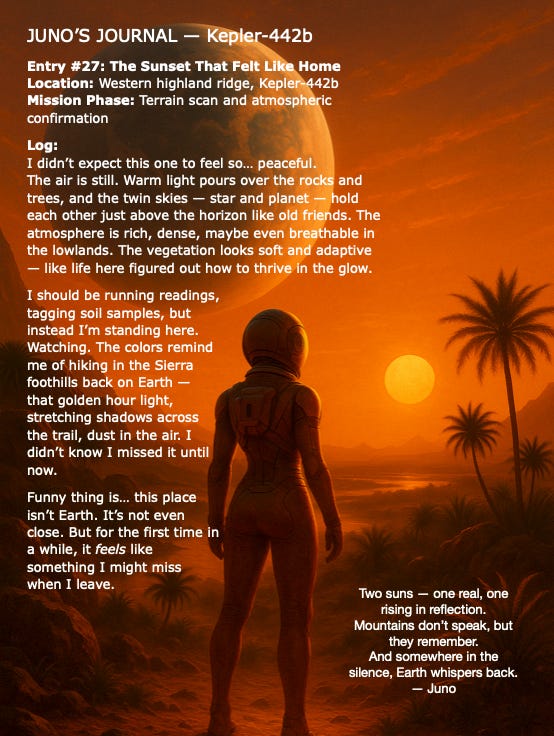
Kepler-442b
The Almost-Earth


This world feels like home… but look a little closer, and you’ll see it’s not.
Kepler-442b orbits in the “Goldilocks zone” — the perfect distance from its star for liquid water. It’s rocky, not too hot, not too cold, and just the right size. If Earth had a cousin in another part of the galaxy, this might be it.
But it’s also strange in ways Earth never dreamed of…
What’s in the Image:
You’re standing on the surface of Kepler-442b, watching an amber-orange sunset bathe the rocky terrain in golden light. The landscape is filled with alien vegetation — palm-like trees and clustered plants that hint at a breathable atmosphere and the presence of water.
Overhead looms a massive Earth-like world, filling the sky like a moon on steroids, and beyond that, the soft glow of the K-type star, slightly cooler and dimmer than our Sun but still powerful enough to support life.
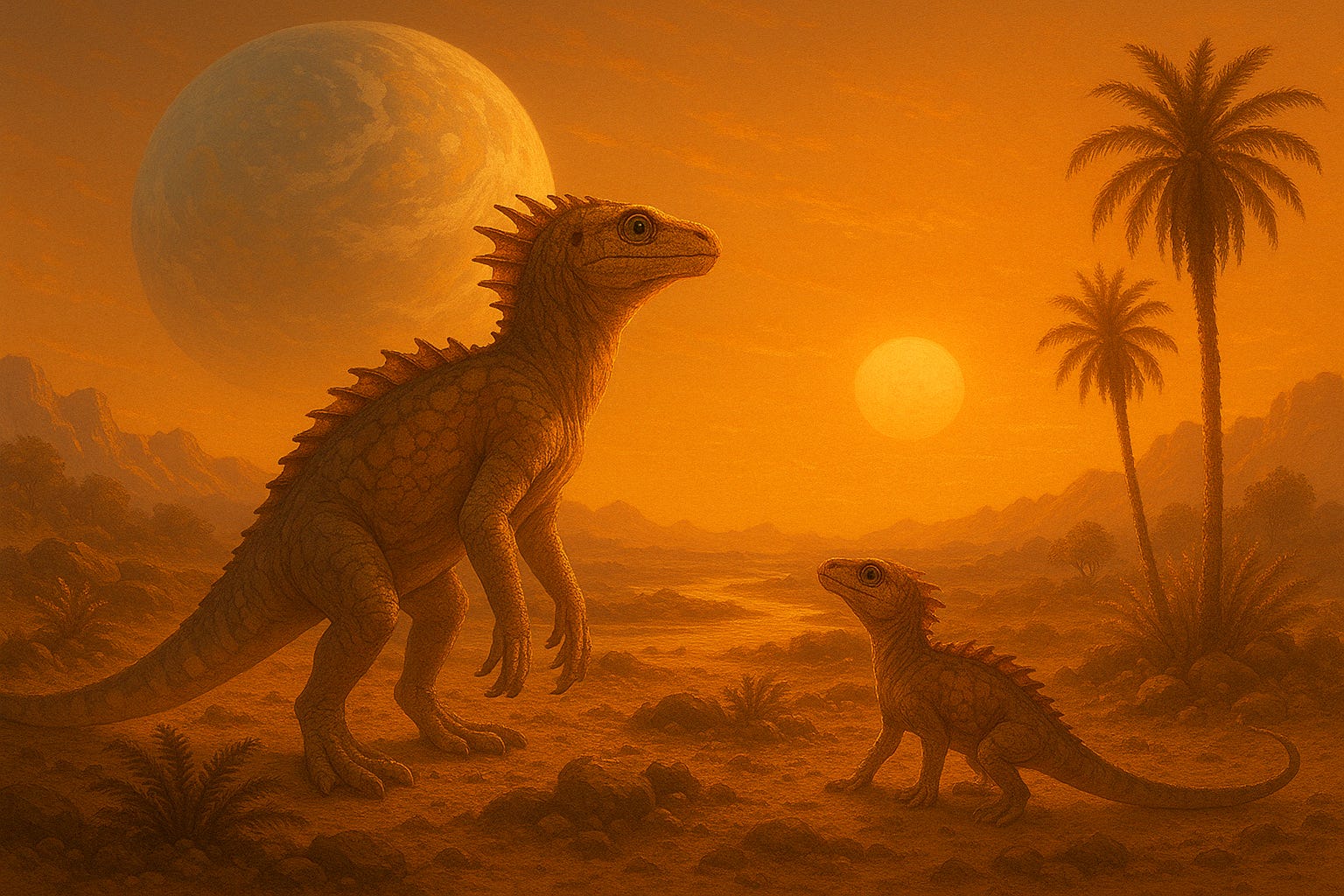
What May Be…The Science Behind The Image
1. The Creatures:
These alien animals are reptilian analogs — meaning they're similar in form to some Earth dinosaurs but evolved under very different conditions. On a high-gravity world like Kepler-442b (estimated to be 40% more massive than Earth), creatures might develop thick limbs, low center of gravity, and dense musculature to move efficiently. Their scales and spines might serve both for thermoregulation and species signaling.
2. Photosynthetic Life:
The vegetation suggests plant analogs adapted to absorb the light of a K-type star. Since this star emits more orange and infrared light than blue, plants here might not be green. Instead, they may favor darker pigments — red, black, or even metallic — to absorb as much useful energy as possible.
3. Atmospheric Effects:
The warm, hazy skies come from a thicker atmosphere full of particles that scatter long-wavelength light (red/orange) rather than short (blue). This effect — similar to Earth’s sunsets but constant — gives the whole world its amber glow.
4. The Large Body in the Sky:
That’s either a massive companion planet or Kepler-442b’s host planet, if this is actually one of its moons. In exoplanet systems, large gas giants could have rocky moons in the habitable zone, and such a moon would see its parent planet rise enormous in the sky.